How to Use Urine Test Strips at Home: A Simple Guide

Taking a urine test to check the presence of glucose, ketone bodies, or other protein molecules in the urine has become a common practice. As the method is easy and non-invasive, patients prefer to get a urine test kit and perform the test in the privacy and comfort of their homes. However, most people ask about how to use urine test strips at home to get reliable results with minimal risk of error.

Urine test strips come with numerous test squares to check different components
In this article, we will address the question of how to use urine test strips at home to find the best results. In addition, some of the well-known urinary test product brands have also been linked for the reader’s convenience.
What is a Urine Test?
A urine test or urinalysis is a method of checking the urine to find out about a patient’s health state. It is the test in which you are required to ‘pee in a cup’ to give a urine sample. This sample is then checked in three ways: visually, chemically, and microscopically to evaluate the presence or absence of certain proteins, ketones, glucose, blood, etc.
Although a urine test is conducted in a laboratory, this can also be performed at home using a suitable urine test strip (linked below). This way, diagnosing urinary tract infections, diabetes, and kidney or liver disorders becomes easy.
How to Use Urine Test Strips at Home?
When it comes to learning about how to use urine test strips at home, you must follow the step-by-step procedure to minimize the risk of errors as well as to elevate the accuracy of the results. These results can then be further interpreted to make a diagnosis (always confirm your findings by consulting a healthcare provider).
The given section provides a guide on how to use urine test strips at home:
Wash Your Hands
The first step of learning about how to use urine test strips at home is to collect a fresh urine sample. To do so, remember to wash your hands using an antibacterial soap, which should be thoroughly rubbed for at least 20 seconds.
Afterwards, use warm water to rinse the soap and dry your hands with a clean, single-use paper towel. If you are taking a urine sample from a patient as a caregiver, medical gloves should be worn after washing and drying the hands. This helps build a layer of added protection while handling the bodily fluids of another person.
Wipe the Urinary Opening
The next step while learning how to use urine test strips at home is to clean the urinary opening with a sterile wipe. This practice will help eliminate bacteria and other germs from the area and prevent their presence in the urine sample. Resultantly, the sample does not get contaminated, and the risk of a false positive UTI result is also avoided.
Collect a Urine Sample
Now, urinate a small amount in the toilet, as this initial amount is not suitable for urine sampling. Then place the urine collection container underneath the urethra or penis tip and urinate in it. While learning how to use urine test strips at home, keep in mind that the container should be half-filled with the urine sample.
Place the lid on the container to prevent contamination from the environment. Also, confirm with your healthcare provider if you need a sterile sampling container, as it is necessary for certain tests.

Testing a urine sample using a strip only takes 2 minutes
Dip the Urine Test Strip into the Sample
At this stage of learning how to use urine test strips at home, take a new strip from the container and hold it from the side that is thicker. You will notice that the strip has numerous colored markings or test squares on it. Each of these is for a different kind of result.
Most test strips have 5 test squares that cover pH, glucose, blood, ketones, and protein testing. However, the ones with 7 squares also allow the detection of bilirubin and urobilinogen in the sample.
Now, open the lid of the container with the fresh urine sample and dip the test strip in it. Make sure to fully submerge the strip to cover each test square.
Take Out the Saturated Test Trip
Once the urine test strip is in the sample, let it get saturated. Now, carefully remove it from the sample and clean using an absorbent paper towel or filter sheet. This will prevent the dripping of the urine from the strip by soaking them.
However, while learning how to use urine test strips at home, remember not to scrub the strip too much, as a small amount of urine is needed to remain on the test squares to conduct the reaction. Also, remember not to shake the urine test strip or blot it with another item.
“Always hold the urine test strip in a horizontal position, facing upwards. This will ensure that urine as well as the reactive chemicals from one test square does not get mixed with another.”
Wait for the Strip to Change Color
When it comes to learning how to use urine test strips at home, remember that the results are indicated by color changes on the test squares. This color change happens after the urine has reacted with the chemical reagents present in the squares.
For this purpose, most test strips need anywhere between 30 to 120 seconds to produce a result. To be precise, set a timer of 120 seconds on your phone. You can also keep an eye on the test strip to visualize these color changes.
Compare the Test Squares to the Color Chart
For a home-based analysis of the urine test results, a color chart is provided with the strips. It can come printed on the packaging itself or provided as a separate sheet or card within the package. To ease the comparison of the urine test strip to the provided chart, every brand provides usage instructions as well.
Always go through them before starting the analysis while learning how to use urine test strips at home. Now, once the 120 seconds or 2 minutes have passed, take the test strip and compare it to the provided color chart.
“Never wait for more than the recommended time as the longer the reaction between the urine and reagents take place, the greater is the chance of a false positive result.”
Interpretation of the Results
Now, the next step of learning how to use urine test strips at home is to interpret the obtained results. To do so, check the colors of the corresponding squares. For example, a cyan hue indicates a higher level of proteins in the urine sample, which can be seen against “PRO”, an abbreviation for protein. Similar is the case for other components that might be present in the urine sample.
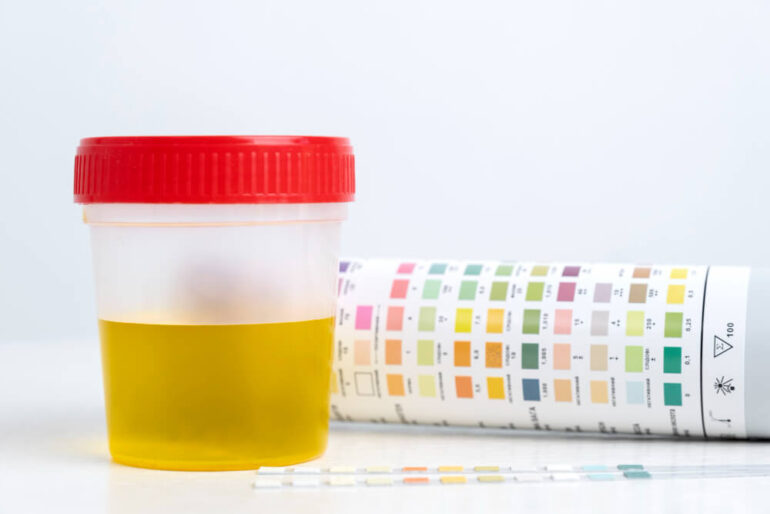
Most containers have the color chart printed on the packaging
Urine Test Products at Health Supply 770: Features and Specifications
A urine test is done on a urine sample collected from a patient to find out what is the internal state of the body. This is a non-invasive procedure that is simple to conduct and gives quick results. As urine test is broad term, it is inclusive of different kinds of tests, all of which might not be conducted on every patient.
When it comes to learning about how to use urine test strips at home, it is also essential to look into some of the products that many brands manufacture. Some of these well-known brands are also available at Health Supply 770 and have been detailed below, along with their features and purchase links:
McKesson Medsurg 121-10SG Urine Test Strip, 10SG F/121-120ANALYZ (VL/1)
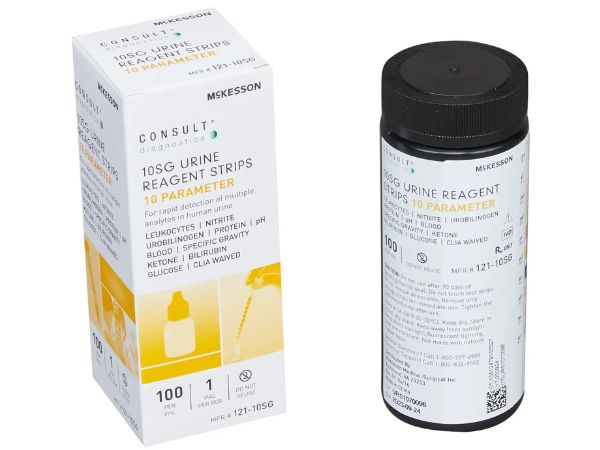
MCKESSON MEDSURG 121-10SG Urine Test Strips – 100 Strips/Box
US$62.22
Product Details
McKesson Medsurg 121-10SG urine test strips are employed for the analysis of urine samples. These are considered superior to many other urine test strip brands as they allow the analysis of 10 key urine parameters at the same time. These include pH, blood, leukocytes, glucose, protein, nitrite, ketone, and specific gravity. In addition, the estimation of bilirubin as well as urobilinogen is also possible.
Furthermore, as these McKesson Medsurg 121-10SG urine test strips are CLIA-waived, their use in physician’s offices, point-of-care settings, as well as clinical laboratories is extensive. While learning how to use urine test strips at home, people often ask about the expiry of the product.
In this regard, these McKesson Medsurg 121-10SG urine test strips have a shelf-life of up to 24 months. However, these can expire earlier if improperly stored, as the ideal storage conditions involve keeping them at room temperature in a tightly capped storage jar.
Moreover, these McKesson Medsurg 121-10SG urine test strips are individually packed to reduce the risk of contamination and maximize stability as well as accuracy. As for their applications, these urine test strips help screen urinary tract infections, metabolic disorders, as well as kidney-related diseases.
Siemens Medical 10336425 Urine Test Strips, Multistix 10SG 2161 (100/VL=EA)

SIEMENS MEDICAL 10336425 URINE TEST STRIP, MULTISTIX 10SG 2161 (100/VL=EA)
Product Details
Siemens Medical 10336425 urine test strips are one of the best products in their domain. While learning about how to use urine test strips at home, rapid results are necessary. Therefore, these products are well-known as they produce the results within 1 to 2 minutes after the strip has been submerged into the urine sample.
Moreover, these Siemens Medical 10336425 urine test strips are also considered suitable for the management of diabetes as they let the patient know the level of glucose in the urinary sample. Furthermore, the product can also be used to check the microalbumin or albumin:creatinine ratio, a parameter necessary for analyzing kidney health.
Roche Diagnostic 3260763160 Urine Test Strip, CHEMSTRIP 10 MD (100/VL)

ROCHE DIAGNOSTIC 3260763160 URINE TEST STRIP, CHEMSTRIP 10 MD (100/VL)
Product Details
Roche Diagnostic 3260763160 urine test strips come with multiparameter visual reagents that produce prominent color changes upon reaction with the urine sample. This way, the estimation of the results becomes quick and easy.
While learning how to use urine test strips at home, the interference of vitamin C with the reagents in the test strips is often a concern. In this regard, these Roche Diagnostic 3260763160 urine test strips have been designed to resist this interference and still produce an accurate result.
Moreover, these Roche Diagnostic 3260763160 urine test strips have a shorter result producing time that ranges between 1 to 2 minutes. As the color change can be observed in all test squares at the same time, all the reagent pads can be read simultaneously.
Furthermore, these Roche Diagnostic 3260763160 urine test strips are employed for checking how well the patient’s kidneys and liver are working. Additionally, these also help make a diagnosis and evaluation of metabolic disorders.
*Note: The prices of these items mentioned in the article are taken from the Health Supply 770 website. These may vary over time.

A fresh sample should be collected each time before conducting a urine test
The products mentioned in this article, while learning about how to use urine test strips at home, along with many other medical supplies, can be purchased from Health Supply 770, a reliable name when it comes to medical products. They have a 30-day money-back guarantee and provide your products to you in the shortest possible time. Click the link at the end of the article to check the wide range of urinalysis-related products.
Conclusion
A urine test is a process of examining the urine to find out the possible disease states in the body. Being a non-invasive procedure, a urine test can also be performed at home. This involves conducting a dipstick test that can be done by simply submerging the test strip into a fresh urine sample.
While learning how to use urine test strips at home, keep in mind that following the correct process is important so that the results can have maximum reliability. This way, these can be shown to the healthcare provider for further guidance or making an amendment in the current dosage regimen.
Considering their importance, urine test strips should be kept in healthcare facilities as well as in home settings to use whenever necessary. For purchasing different types of urine test products, reliable vendors like Health Supply 770 should be approached. They ensure the provision of quality products along with satisfactory services.
Read also
How to Prepare for a Urine Test: Everything You Need to Know