Colposcopic Examination vs Pap Smear: Key Differences
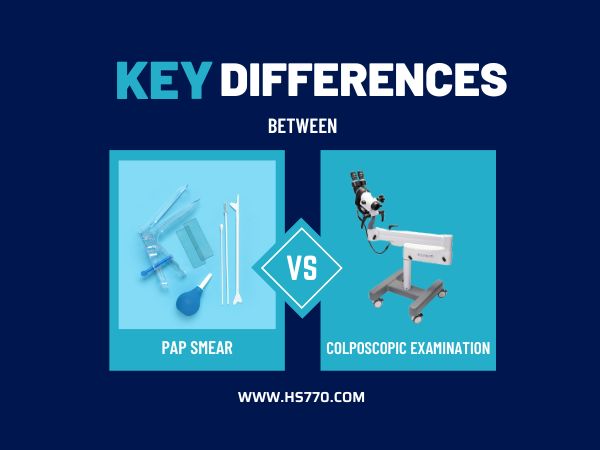
According to the Centers for Disease Control and Prevention (CDC), about 4,000 women die every year in the United States because of cervical cancer. The disease, however, is treatable if diagnosed at an early stage. But the problem lies in the fact that at this point, patients do not feel any symptoms associated with the disease. Therefore, detection is only possible with a Pap smear or a colposcopic examination.

Colposcopic examination is necessary if the Pap smear results are not normal
In this article, we will learn about the difference between colposcopic examinations vs Pap smears. Additionally, some well-known colposcope brands are listed below for the reader’s convenience.
What is a Colposcopic Examination?
A colposcope is a diagnostic tool based on the principles of microscopy. A colposcopic examination provides a magnified view of the internal tissues that renders the examination easy. Moreover, some of these colposcopes also have a camera and a monitor attached to them so that images and videos of the area can be taken and saved for documentation purposes.
Purpose
This low-power device is employed for a thorough examination of the vulva, vagina, and cervical tissue to detect abnormalities in the cellular structures as well as the presence of non-cancerous or cancerous lesions.
Method
To conduct a colposcopic examination, a pelvic test is scheduled. The patient is asked to lie down on their back with feet raised. A speculum is placed in the vagina to keep the orifice wide open. Now, the colposcope is placed at the opening of the vagina.
The internal tissues are visualized using the binoculars of the colposcope. Magnification of the device can be changed to see a clear image that can be visualized on the monitor.
A colposcopic examination takes nearly 4 minutes to conduct and is not painful. Although some patients may feel a slight pinch or cramp in case of tissue sampling. In such cases, when a sample of the tissue is taken for further analysis, the procedure is then called a biopsy.
Possible Findings
When it comes to the results of a colposcopic examination, the following findings are possible:
Normal Results
A normal result of the colposcopic examination means that no abnormal cells have been detected in the cervical area, indicating it is healthy with a low risk of cancer.
Non-Cancerous Abnormalities
If the colposcopic examination indicates the presence of abnormal cells, a biopsy can confirm if these are cancerous or not. In case of non-cancerous abnormalities, the presence of these cells means a precancerous condition such as cervical glandular intraepithelial neoplasia (CGIN), etc.
In such cases, proper treatment is given to the patient that can reverse these abnormalities. However, frequent colposcopic examinations are also needed to check the efficacy of the therapy. In addition, issues like inflammation or infections are also easily detected by colposcopy.
Cancerous Abnormalities
If the abnormal cells are cancerous, these indicate cervical cancer that can be confirmed by a biopsy. In case of an early detection, studies have shown a 5-year relative survival rate of 91%. This means that 91% of women with an early-stage cervical cancer will be alive after 5 years of their diagnosis.
Understanding a Pap Smear: The Screening Tool
What is a Pap Smear Test?
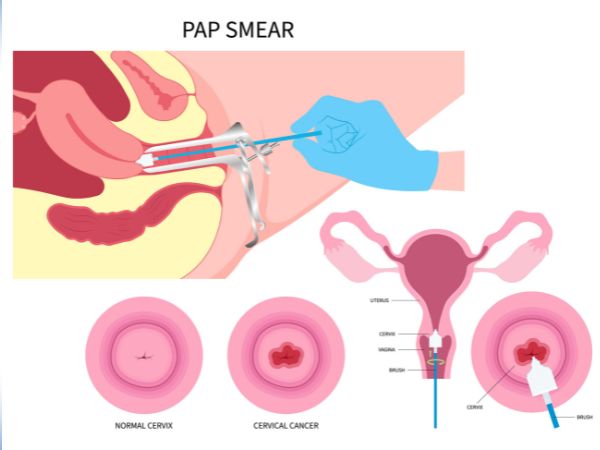
The Pap smear or Pap test is a diagnostic method employed for screening patients for cervical cancer. The test is designed to check if the cells of the cervix (lower part of the uterus) or vagina (birth canal) have become abnormal, either due to an infection or cancer.
Purpose
Pap smear is performed to look for the signs of any abnormality in the cervical tissue. The test can also indirectly indicate the presence of infections related to human papillomavirus (HPV). This is because the test can detect the cellular changes that can be associated with HPV. In addition, a Pap smear can be used to detect inflammation in the internal reproductive tissue.
Method
Pap smear is a simple and quick test that is performed using an instrument called a speculum. The person is asked to lie down on the examination table. The speculum is then inserted into the uterus through the vagina. This holds the cavity open so that the internal tissues can be visualized. If there are lumps, sores, inflammation, or other abnormalities in the cervical tissue, this can indicate the presence of a non-cancerous or cancerous mass associated with a disease.
A disposable swab or soft-bristled broom is then inserted into the cavity to collect a sample of the cervical cells. These cells are then placed on a glass slide and examined under a microscope. Although the test is painless, women may feel uncomfortable during the process.
Possible Findings
If your Pap smear results indicate normal cervical cells, there is nothing to worry about. However, as per the recommendations of the Centers for Disease Control and Prevention (CDC), the following guidelines should be followed based on the woman’s age:
¨ For women between the ages of 21 and 29 years, a three-year gap between two tests is recommended if the results are normal.
¨ For women between the ages of 30 and 65 years, if the HPV test is normal, the next screening can be planned for 5 years after the initial testing. If the Pap smear is normal, the next Pap test should be scheduled after 3 years. In addition, a co-testing can also be done that involves doing an HPV and Pap smear at the same time. In case of a normal result, a five-year period is suitable to schedule the next test.
¨ For women older than 65 years old, you can skip Pap smear altogether if:
- The patient has gone through at least 3 Pap smear tests and 2 HPV tests in the past 10 years, all of which have indicated negative results
- The patient does not have a history of cervical pre-cancer
- Cervix has been removed for non-cancerous conditions like fibroids
In case of an abnormal result of the Pap smear test, a colposcopic examination is recommended to further evaluate the condition.

Patients should be guided about the right screening interval depending on their present test results
Colposcopic Examination vs Pap Smear: Key Differences
Both colposcopic examinations and Pap smear have their purposes and advantages. The following table illustrates some of the key differences between a colposcopic examination and a Pap smear test:
| Features | Colposcopic Examination | Pap Smear |
| Purpose | Helps visualize cervical tissue | Detects cervical abnormalities |
| Method | The cervix is viewed with binoculars | Cells are scraped from the cervix and seen under a microscope |
| Findings | Visual assessment and biopsies | Indicates normal or abnormal cells |
| Sensitivity and Specificity | High, especially when performed with a biopsy | Lower than a colposcopic examination |
| Accuracy | High | Lower than colposcopy |
| Cost | Expensive as compared to a Pap smear | Less expensive than a colposcopic examination |

Regular screening is necessary to ensure the health of the female reproductive area
Colposcopes at Health Supply 770: Features and Specifications
Colposcopes are low-power microscopic instruments that are ideal for the examination of vaginal and cervical tissue. These have a few key components that include binoculars, a light source, a magnification changer, and adjustment knobs, among others. In addition, the digital models also carry a camera and monitor so that the internal view can be observed on a larger screen.
When it comes to learning about colposcopic examination, it is also essential to look into some of the products that many brands manufacture. Some of these well-known brands are also available at Health Supply 770 and have been detailed below, along with their features and purchase links:
MedGyn 010199 AL-101 Colposcope
MedGyn 010199 AL-101 Colposcope
US$3,809.88
Product Details
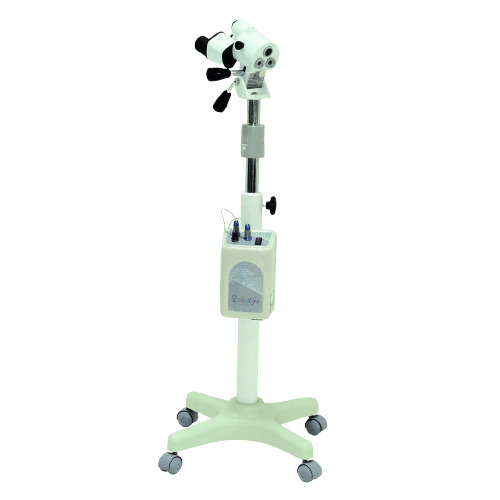
MedGyn 010199 AL-101 colposcopes are the products that are designed to examine the cervical and vaginal area to confirm the presence or absence of any abnormal mass. The devices are easy-to-use systems that come with a high-definition imaging feature. In addition, the 1-step magnification feature also adds to the clarity of the internal tissues.
Moreover, these MedGyn 010199 AL-101 colposcopes also have green filters in them that make the visualization of the blood vessels possible. As for the eyepieces, these come with a 12.5X magnification.
Furthermore, these MedGyn 010199 AL-101 colposcopes have a sturdy stand on their base that provides stability during a colposcopic examination. Overall, the product is small in size and, therefore, suitable for small practices that are looking for an affordable option.
MedGyn 010200 AL-102 Colposcope
MedGyn 010200 AL-102 Colposcope
US$4,984.88
Product Details
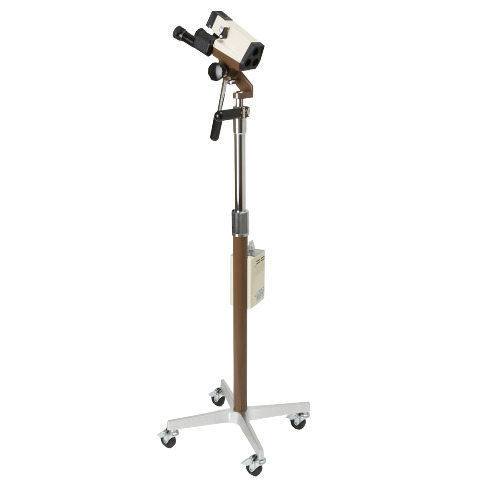
MedGyn 010200 AL-102 colposcopes are the low-power microscopic tools that are employed for conducting colposcopic examinations that involve the inspection of the vaginal and cervical tissue. The product comes with adjustable eyepieces in terms of their magnification that have the options 10X, 13.5X, and 18X. In addition, the two interchangeable eyepieces are also excellent in producing a high-definition image.
Furthermore, these MedGyn 010200 AL-102 colposcopes are easy to use as well and, therefore, produce quick results. Additionally, these devices also come with 3-position, electronically controlled illumination settings that allow the examiner to adjust the light intensity depending upon the procedure to be conducted.
Moreover, the visualization of the blood vessels in the cervical area is also possible during colposcopic examination because of the green filter attached to the device. The images and videos of the internal cervical structures can also be taken and saved for the purpose of documentation. Overall, the device is easy to use and comes with a stable stand at the base that can be tilted to adjust its position.
MedGyn 010505 AL-105Z 5-Step Colposcope with Swing Arm
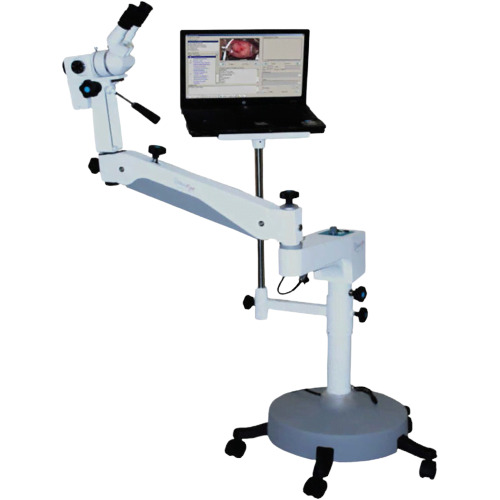
MedGyn 010505 AL-105Z 5-Step Colposcope with Swing Arm
US$13,044.88
Product Details
MedGyn 010505 AL-105Z 5-step colposcope with swing arm is often preferred for colposcopic examination. The system contains powerful binoculars with an attached tubing that provides an incline at an angle of 45 degrees. In addition, the 360-degree rotation feature ensures that the system can cover all the cervical tissue during the examination.
Moreover, these MedGyn 010505 AL-105Z 5-step colposcopes with swing arms also come with a 5-step magnification system that allows adjustment at different options, including 0.4X, 0.6X, 1X, 1.6X, and 2.5X magnification options. In addition, the system also has a coaxially reflected optical fiber illuminator that acts as a light source, the brightness of which can also be adjusted due to the 3-step illumination control feature.
As for their height, these colposcopic examination systems can be set at two height settings, i.e., a maximum height of 54.5” (137 cm) from the floor to the objective lens. As for the minimum distance between these two points, a height of 48” (81 cm) can be set.
Furthermore, these MedGyn 010505 AL-105Z 5-step colposcopes with swing arms can also be inclined between angles of 0 to 90 degrees as their main body is adjustable. Due to their superior quality and excellent features, these colposcopic examination systems are preferred for use within hospitals, clinics, and private offices.
*Note: The prices of these items mentioned in the article are taken from the Health Supply 770 website. These may vary over time.

Proper guidance must be provided to women regarding their vaginal health
The colposcope mentioned in this article, while learning about the differences between the colposcopic examination vs Pap smear, along with many other medical supplies, can be purchased from Health Supply 770, a reliable name when it comes to medical products. They have a 30-day money-back guarantee and provide your products to you in the shortest possible time. Click the link at the end of the article to check the wide range of colposcopes.
Conclusion
Cervical cancer is one of the most prevalent forms of cancer among middle-aged women. However, it is one of those diseases that, if diagnosed at an early stage, can be easily treated. To do so, a Pap smear test followed by a colposcopic examination is recommended.
The detection of abnormalities after a Pap smear indicates the need for a colposcopic examination. Both of these differ in terms of their conduction, accuracy, sensitivity, and cost. In a Pap smear, a sample of cervical cells is collected using a swab and analyzed under a microscope. However, in colposcopic examination, the cervical tissue is viewed using binoculars. Therefore, both have their benefits and efficacies and are suitable for different stages of cervical examination.
Considering their importance, colposcopes should be kept in healthcare facilities to conduct a cervical or vaginal examination. For purchasing different types of colposcopes, reliable vendors like Health Supply 770 should be approached. They ensure the provision of quality products along with satisfactory services.
References
https://www.cdc.gov/cervical-cancer/statistics/index.html
https://www.cdc.gov/cervical-cancer/screening/index.html
https://www.cancer.gov/types/cervical/survival