Lactated Ringer Ingredients: What’s in the Bag?

Lactated Ringer’s solution is one of the widely used intravenous solutions in medical settings. It is often administered to patients dealing with dehydration or blood loss due to physical trauma. The idea is to inject ionic species into the blood that are necessary for maintaining a healthy electrolyte balance in the body. In this regard, diving deep into the lactated Ringer ingredients is essential to understand how each of these plays an essential role in restoring normal blood chemistry.

Administration of lactated Ringer’s solution effectively treats dehydration
In this article, we will learn about the lactated Ringer ingredients and their uses in medical setups. Additionally, some well-known intravenous solution brands are listed for the reader’s convenience.
What is Lactated Ringer’s Solution?
Lactated Ringer’s (LR) solution is a sterile, isotonic, and non-pyrogenic intravenous solution that is frequently used in healthcare settings to restore lost electrolytes and fluid balance after dehydration or a traumatic injury.
In addition, the solution is also useful for wound flushing and can manage metabolic acidosis. Other names for the lactated Ringer’s solution are Ringer’s lactate solution (RL), sodium lactate solution, and Hartmann’s solution.
Lactated Ringer Ingredients and Their Concentrations
When it comes to learning about the lactated Ringer ingredients, let us start from the names and concentrations of the components. In this regard, the following table enlists these values for 1000 ml or 1 liter of the solution:
| Lactated Ringer Ingredients | Formulae | Concentration (g/L) |
| Sodium chloride | NaCl | 6.00 g |
| Potassium chloride | KCl | 0.30 g |
| Calcium chloride, dihydrate | CaCl2.2H2O | 0.20 g |
| Sodium lactate | C3H5NaO3 | 3.10 g |
In addition, the lactated Ringer’s solution may also contain hydrochloric acid (HCl) and/or sodium hydroxide (NaOH). The purpose of these two is to adjust the pH of the solution, which should be maintained at 6.6 (6.0 to 7.5). As for its osmolarity, the lactated Ringer ingredients render the solution 273 mOsm/liter.
Milliequivalents of Ionic Species in Lactated Ringer’s Solution
In addition to concentration, another essential factor often mentioned about the lactated Ringer ingredients is the number of reactive sites they provide in the blood. This is important because our blood is based on a sensitive balance of sodium, potassium, calcium, and chloride ions, and any disturbance in their levels, either an increase or a decrease, can impact its overall chemistry.
In this regard, the given table mentions the milliequivalents of the ionic species that are an essential part of lactated Ringer ingredients:
| Lactated Ringer Ingredients | Charged Species | Milliequivalents (mEq) |
| Sodium | Na+ | 130 |
| Potassium | K+ | 4 |
| Calcium | Ca2+ | 3 |
| Chloride | Cl– | 109 |
| Lactate | CH3CH(OH)COO– | 28 |

IV solutions are necessary for almost every hospitalized patient
Significance of Lactated Ringer Ingredients
While learning about the lactated Ringer ingredients, it is fair to dive deeper into each component and understand how it will act once infused into the blood. Therefore, the given section summarizes the role of each of the lactated Ringer ingredients:
Sodium Chloride
When it comes to learning about the salt content of our blood, sodium chloride tops the list. This is because of its numerous uses in the body that render it essential. Being one of the lactated Ringer ingredients, sodium chloride dissociates to form one sodium (Na+) and one chloride (Cl–) species. Between these, sodium plays a role as the principal cation of the extracellular fluid. Therefore, it helps regain the lost balance of electrolytes and fluid in the body.
On the other hand, chloride ions play an integral role in buffering action in the red blood cells, where an exchange between oxygen and carbon dioxide occurs. To excrete these ions from the body, kidney plays an important role.
Potassium Chloride
In a solution, potassium chloride dissociates to form potassium (K+) and chloride (Cl–) ions. In our blood as well as in extracellular fluid, potassium is naturally found in low concentration, i.e., around 3.5 to 5.0 mEq/L in a healthy human being. However, in our intracellular water within the cells, potassium enjoys the status of being the chief cation with a value of 160 mEq/L.
As for the excretion of potassium from the body, 80 to 90% of its clearance is based on urinary excretion, while the rest is divided between feces and sweating. In case of consuming a potassium-free diet, our kidneys keep on excreting potassium from the blood, which results in potassium depletion.
Calcium Chloride
When in the blood, both calcium (Ca2+) and chloride (Cl–) dissociate to generate two ionic species. These two are also part of the naturally present ions in the blood and can, therefore, be taken up by the cells and tissues. Various physiological mechanisms define how a balance between the intake and output of these two ions is maintained.
Furthermore, as for the excretion of these species from the body, nearly 80% of the calcium is cleared out in the form of insoluble salts via feces, while the remaining 20% becomes part of the urine.
Sodium Lactate
Sodium lactate breaks down to generate a sodium (Na+) and a lactate (C3H5O3–) ion. Between these, the lactate ion forms an equilibrium with pyruvate ions. As a result, an alkalizing effect is produced due to the removal of lactate and hydrogen ions from the liver.
When lactate reaches the liver, it gets converted into glycogen and then carbon dioxide and water due to metabolism. On the other hand, sodium reacts with bicarbonate ions in the blood and prevents their breakdown into carbon dioxide and water. Resultantly, bicarbonate deficiency is addressed, and metabolic acidosis is managed.
Water
The final name in the list of lactated Ringer ingredients is water. Being the most essential component of the human body, water constitutes around 70% of the total body weight. To maintain this volume, an average normal adult needs 1.0 to 1.5 liters of water every day to make up for the loss due to urination and sweating.
The water provided to the body by infusing the lactated Ringer’s solution helps manage these losses, which are inevitable in case of dehydration or a physical trauma leading to significant blood loss.

Lactated Ringer’s solution is sterile and colorless
Using Lactated Ringer’s Solution: Warnings
While learning about the lactated Ringer ingredients, it is also essential to look into some of the associated warnings, which have been listed as follows:
- Any solution that contains calcium should not be administered to the patient along with a blood transfusion. This is because when both of these are infused via the same infusion line, the risk of coagulation is increased.
- Before administering solutions containing potassium, ensure that the patient does not have hyperkalemia, severe renal failure, or any other condition that elevates the potassium levels in the body.
- Solutions containing sodium should be avoided in patients with congestive heart failure, severe renal insufficiency, or other clinical conditions that cause edema due to sodium retention. However, if the infusion is necessary, great care should be practiced.
- The administration of solutions with sodium and potassium content should be avoided in patients who have diminished renal function, as the ionic retention is a significant risk.
- In patients with metabolic or respiratory alkalosis as well as severe hepatic insufficiency, solutions containing lactate ion should be administered with great care.
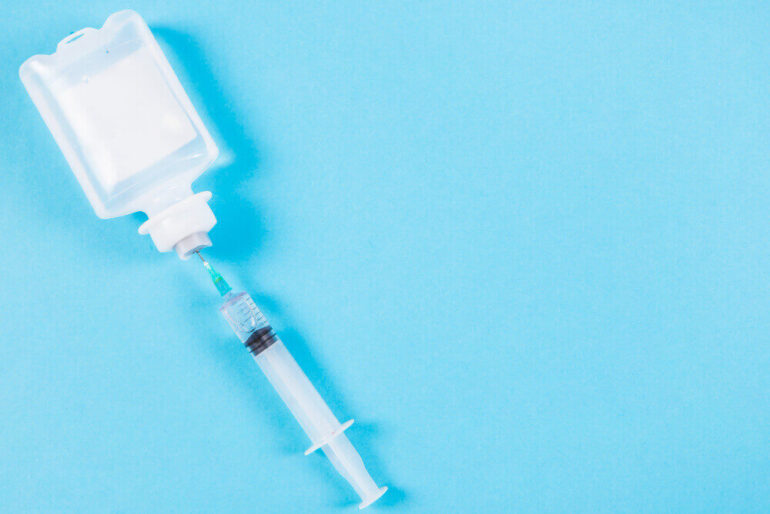
IV solutions replenish the lost electrolytes due to dehydration
Intravenous Solutions at Health Supply 770: Features and Specifications
Lactated Ringer’s solution is widely used in healthcare industries as a vehicle for medications that are delivered directly into the bloodstream. The solution is also useful for cleaning wounds and does not disturb the body’s natural pH.
When it comes to learning about lactated Ringer ingredients and its uses, it is also essential to look into some of the products that many brands manufacture. Some of these well-known brands are also available at Health Supply 770 and have been detailed below, along with their features and purchase links:
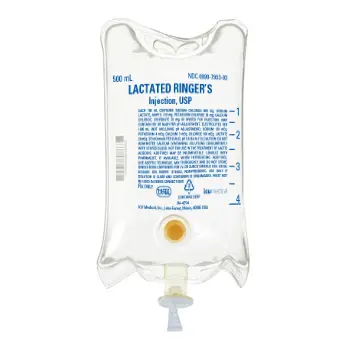
ICU Medical Lactated Ringer’s Injection, USP, 1000 mL (12/Cs)
Product Details
ICU Medical Lactated Ringer’s injection, USP, is a product that is widely employed in hospitals and clinics. Among the lactated Ringer ingredients, chloride salts of some of the essential ions of the body, i.e., sodium chloride, potassium chloride, and calcium chloride, are prominent. In addition, to make the solution an effective remedy against metabolic acidosis, sodium lactate is also incorporated.
These ICU Medical lactated Ringer’s injections, USP, come in flexible plastic bags that can hold a solution up to a volume of 1000 ml or 1 liter. As for its use, the ICU Medical lactated Ringer’s injection, USP, is employed as a vehicle to carry and deliver medications directly into the bloodstream.
Moreover, these ICU Medical lactated Ringer’s injections packaging material contains polyvinyl chloride (PVC) and di(2-ethylhexyl)phthalate (DEHP), both of which are often present in plastic-based medical products. However, due to their allergy-causing nature, caution should be practiced if the patient is sensitive to them.
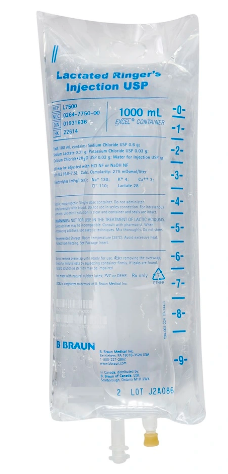
B. Braun L7500 Lactated Ringer’s Solution IV 1000 mL CS/12
US$89.88
Product Details
Braun L7500 lactated Ringer’s solution is a sterile and non-pyrogenic intravenous solution that is used as a fluid replenishing solution. The lactated Ringer ingredients include sodium chloride, potassium chloride, calcium chloride, as well as sodium lactate. Water is used as a vehicle to carry all the ingredients in specified concentrations.
Moreover, these B. Braun L7500 lactated Ringer’s solutions are safe for use even in patients who have a compromised immune system, as they do not contain any added bacteriostatic or antimicrobial agent. In addition, the solution is also sterile and non-pyrogenic.
In addition, these B. Braun L7500 lactated Ringer’s solutions are suitable for use in both pediatric and adult patients. These solutions are employed for the treatment of dehydration as well as other conditions that require fluid replacement.
Furthermore, the packaging material of these B. Braun L7500 lactated Ringer’s solutions are flexible and do not contain toxins such as PVC or DEHP.
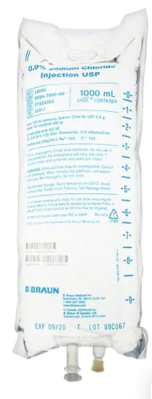
B. Braun L8000 Replacement Preparation Sodium Chloride, Preservative Free 0.9% IV Solution Flexible Bag 1,000 mL 12 EA/CA
US$99.88
Product Details
When it comes to learning about intravenous solutions that are administered to restore the lost electrolyte and fluid balance in the body, the importance of the aqueous solution of sodium chloride is undeniable. In this regard, these B. Braun L8000 replacement preparations are an effective option.
The composition of these B. Braun L8000 replacement preparations contain sodium chloride in water in a concentration of 0.9%. The absence of any preservative makes the solutions even safer, as the risk of a hypersensitivity reaction is eliminated. In addition, the product is also free from latex, a known allergen, as the flexible plastic bag is free from such materials.
*Note: The prices of these items mentioned in the article are taken from the Health Supply 770 website. These may vary over time.

IV solutions help restore the normal blood chemistry
The products mentioned in this article, while learning about the lactated Ringer ingredients and their uses, along with many other medical supplies, can be purchased from Health Supply 770, a reliable name when it comes to medical products. They have a 30-day money-back guarantee and provide your products to you in the shortest possible time. Click the link at the end of the article to check the wide range of IV solutions.
Conclusion
Lactated Ringer’s solution is one of the essential IV solutions in healthcare facilities. It contains chloride salts of sodium, potassium, and calcium along with sodium lactate and, therefore, generates ions of different natures when mixed with water.
When it comes to learning about the lactated Ringer ingredients, it is important to not only look into the components of the solution but also their concentrations as well as the roles they play once injected into the bloodstream.
Considering their importance, lactated Ringer’s and other IV solutions should be kept in healthcare facilities to ease medical procedures. For purchasing different types of intravenous solutions, reliable vendors like Health Supply 770 should be approached. They ensure the provision of quality products along with satisfactory services.