The Direct Ophthalmoscope in Primary Care: A Tool for More Than Just Eyes
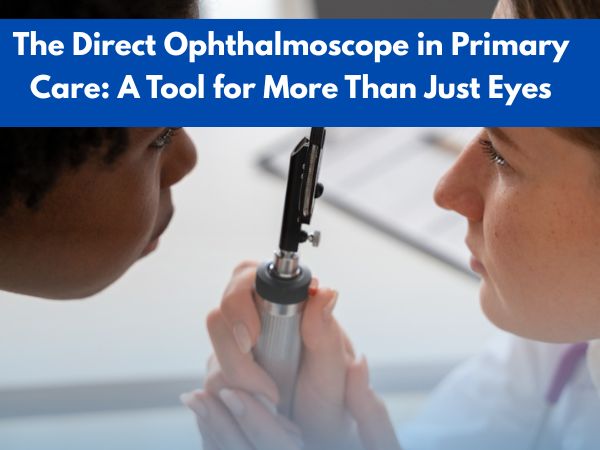
According to the Centers for Disease Control and Prevention (CDC), nearly 12% Americans are suffering from age-related macular degeneration (AMD). In such cases, the patient suffers from blurred central vision and the spresence of dark spots, leading to decreased ability to see, read, and observe, especially finer details. Here, a primary eye examination is recommended using a direct ophthalmoscope, which can reveal if further testing is required.

Direct ophthalmoscopes are extensively used in primary care facilities
In this article, we will go through the basic introduction of direct ophthalmoscopes and their use in primary care. In addition, some of the well-known ophthalmoscope brands have also been linked for the reader’s convenience.
What are Ophthalmoscopes?
An ophthalmoscope is a handheld tool that has been designed to examine the internal parts of the eye called the eye fundus through a process known as ophthalmoscopy or fundoscopy. As the fundus of the eye comprises retina, retinal blood vessels, fovea, macula, and optic disc, the presence of any abnormality or disorder in any of these can be easily diagnosed within a few minutes, i.e., 10 to 15 minutes.
What are Direct Ophthalmoscopes?
Direct ophthalmoscopes are the eye examination tools that are small and compact in their size and shape so much, so that they look like a flashlight. Instead of producing a clear but reversed image as constructed in indirect ophthalmoscopes, the direct ophthalmoscopes provide an upright and unreversed image of the eye fundus. Moreover, the image is also magnified to allow easy visualization.
Components of Direct Ophthalmoscopes
When it comes to their construction, direct ophthalmoscopes are simpler instruments with the following components:
Handle and Power Source
The handle of the direct ophthalmoscopes contains rechargeable batteries and controls of the device. The on/off switch or rheostat allows the user to control the intensity of light shone on the fundus of the eye.
Illumination System
The illumination system is the essential component of the direct ophthalmoscopes as it provides the necessary bright light for the visualization of the eye fundus. In this regard, the device contains a bright halogen bulb or LED, along with two convex lenses that focus the light from the bulb.
A mirror present in the system reflects the light into the patient’s pupil. In addition, an aperture wheel changes the shape of light to allow viewing from different angles.
Viewing System
Finally, the viewing system of the direct ophthalmoscopes consists of an eyepiece or the viewing window from where the healthcare provider/examiner looks into the eye. The brow rest is incorporated in the device to support the examiner’s eyebrows. Additionally, the lens wheel or diopter dial contains the corrective lenses that facilitate the focusing for the examiner by correcting the refractive errors.
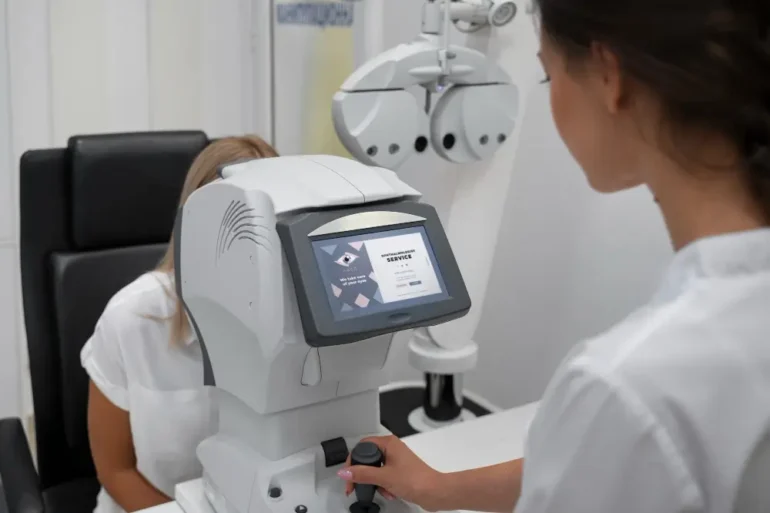
Properly conducted regular eye examination helps diagnose the diseases at their earlier stages
Use of Direct Ophthalmoscopes in Primary Care
As these direct ophthalmoscopes are easily accessible, they are widely employed within primary care units to achieve numerous benefits in terms of eye examination. Some of these benefits are as follows:
Early Detection of Eye Diseases
The use of a direct ophthalmoscope helps the primary care providers (PCPs) to diagnose certain eye diseases even when they are at their earlier stages. These include conditions like:
Diabetic Retinopathy
Diabetic retinopathy or DR is an eye condition affecting diabetic patients by damaging their blood vessels in the retinal. This primarily occurs due to high blood sugar level that leads to either their leakage, closing, or abnormal growth.
As a result, symptoms like blurred vision, dark spots, or blindness are likely to occur. The condition is associated with the appearance of microaneurysms, hemorrhages, or exudates in the eye fundus that can be detected with the help of a direct ophthalmoscope.
Glaucoma
Glaucoma is an eye condition that is associated with damage of the optic nerve, a wire-like structure connecting the eyes to the brain. It occurs due to an increase in the intraocular pressure caused by the fluid buildup. The condition, if it remains undiagnosed, can progress and cause an irreversible vision loss.
When it comes to diagnosing glaucoma, direct ophthalmoscopes come in handy as they can provide a magnified view (up to 15X) of the optic nerve head, which appears to be changed. In addition, enlargement of the optic cup as well as thinning of the neuroretinal rim is also observable, along with the disc hemorrhages.
Macular Degeneration
Macular degeneration or AMD is an eye disorder that causes blurred central vision due to damage in the macular area. As a result, the patient cannot see fine details, leading to difficulty in reading, recognizing faces, driving, etc.
In such cases, the direct ophthalmoscopes are used by primary care providers to make a diagnosis. In such cases, the macula appears to be smaller than usual, darkly pigmented, and slightly inferior to the optic disc. Keep in mind that the macula is the most sensitive area when it comes to light and causes the pupil to shrink as soon as light is shone on it. Therefore, macular analysis should be done at the end of the eye fundus examination.
Pediatric Screening
Direct ophthalmoscopes also come in handy while diagnosing disorders among pediatric patients. This includes screening them for sight-threatening issues, like refractive errors, such as myopia or hyperopia, cataracts, problems of the optic nerve, retinal abnormalities, etc. In addition to making a diagnosis, the device is also cost-effective and can, therefore, be widely used in primary healthcare facilities.
Indication of Systemic Issues
Another advantage of the direct ophthalmoscopes is their role in the diagnosis of systemic issues, such as hypertension, risk of stroke, etc. This is because hypertension or high blood pressure leads to altered blood flow in retinal blood vessels, often leading to a condition known as hypertensive retinopathy.
Here, the blood vessels (particularly arteries) appear to be narrowed, along with signs of hemorrhage, which can be seen using a direct ophthalmoscope. In addition, the presence of Roth spots (white-centered, red-colored spots on the retina) in the eye also indicates heart infections, leukemia, anemia, as well as preeclampsia, among other conditions.
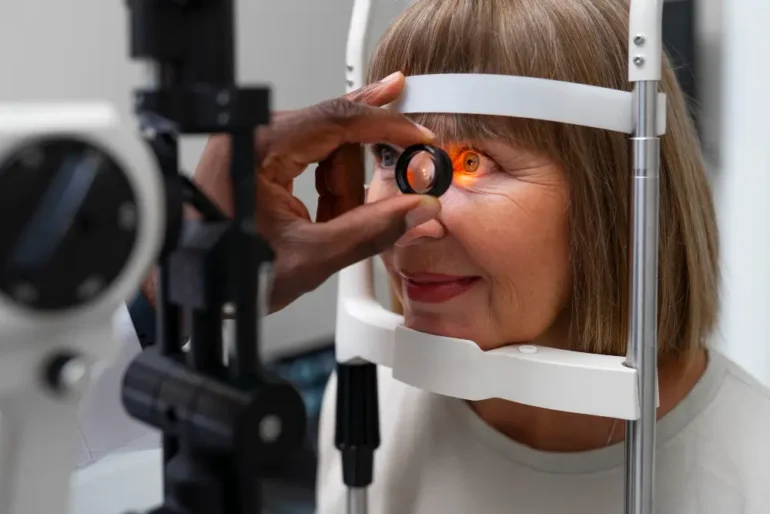
Retinal tear or detachment is detectable with the help of a direct ophthalmoscope
Limitations of Direct Ophthalmoscopes
Despite their several benefits, direct ophthalmoscopes have some limitations as well that restrict their vast applications. The following section covers some of them:
Narrow Field of View
As the direct ophthalmoscopes have a tiny window for viewing the retina, it might become difficult for the examiner to visualize the fundus of the eye without putting strain on their eyes. This can make the detection of retinal spots hard, leading to an inaccurate diagnosis. In addition, the overall duration required to examine the whole fundus is also comparatively high.
Monocularity
Direct ophthalmoscopes are single-eye instruments that can only provide a 2-dimensional image of the eye fundus. Therefore, a fully comprehensive eye examination might not be possible.
Limited Applications
These direct ophthalmoscopes cannot visualize the far peripheral retina. Therefore, conditions like retinal tears or detachments are difficult to diagnose.
Lower User Confidence
As the usage method of direct ophthalmoscopes is comparatively difficult, an accurate application requires significant practice. In addition, it is also hard to interpret the results if the examiner is not trained enough. Resultantly, overall user confidence is lowered.
Need for Patient Cooperation
The direct ophthalmoscopes work best when they are used very close to the patient’s eye. This much proximity often makes the patient uncomfortable. In addition, the patient’s mobility during the procedure impacts the accuracy, especially in the case of pediatric patients.
Need for Further Testing
As direct ophthalmoscopes are only suitable for eye examination in primary care units, they have a limited accuracy as compared to detailed advanced fundus imaging systems. Therefore, the referral rate is extremely high.

Pupil-dilating eye drops are used before the process to ease examination
Ophthalmoscopes and Related Parts at Health Supply 770: Features and Specifications
Ophthalmoscopes are handheld instruments used for the visualization of the fundus of the eye. It is an easy to use system that works by shining a bright light into the eye, leading to its reflection. This way, several eye disorders can be diagnosed even at their earlier stages.
However, when it comes to learning about direct ophthalmoscopes, it is also essential to look into some of the products that many brands manufacture. Some of these well-known ophthalmoscopes and their related parts are also available at Health Supply 770 and have been detailed below, along with their features and purchase links:
Welch Allyn Coaxial Ophthalmoscope for Eye Examination– 3.5V LED 11720-L
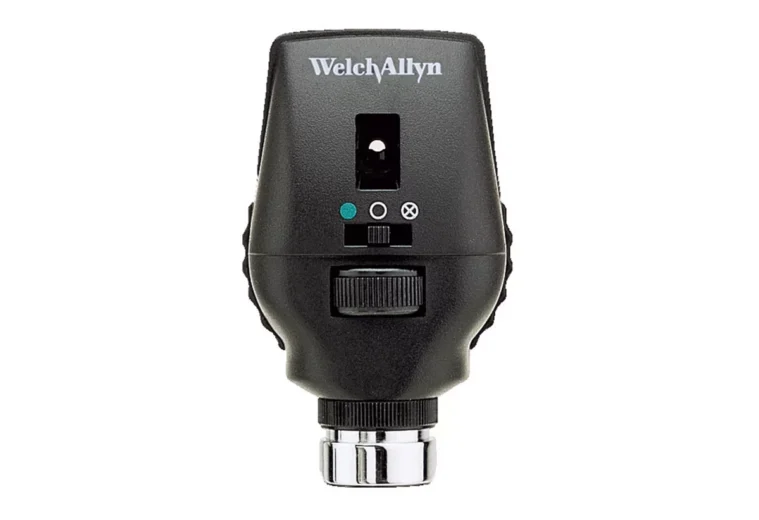
Welch Allyn Coaxial Ophthalmoscope for Eye Examination– 3.5V LED 11720-L
US$264.88
Product Details
Welch Allyn coaxial ophthalmoscope is a handheld tool that is employed in healthcare facilities for the examination of the eye fundus during a process called fundoscopy or ophthalmoscopy. The product is known for producing a clear image of the internal eye that allows a quick and easy diagnosis of eye diseases. Moreover, the product also ensures that the image produced during the examination is not blurred or affected by shadow as the production of glare is eliminated.
When it comes to light source, these Welch Allyn coaxial ophthalmoscopes come with a 3.5V LED illumination that is long-lasting and, therefore, does not need frequent recharging or battery changes. In addition, as the system is suitable for meeting the varying diagnostic needs, it comes with 18 unique aperture or filter combinations. The product can be used with all other Welch Allyn equipment.
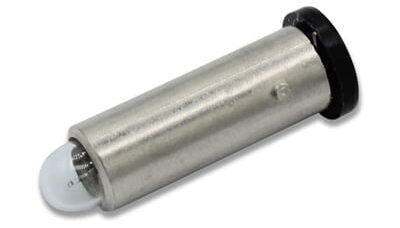
Welch Allyn 03000U6 3.5V Halogen Lamps, Ophthalmoscope for 11710/8000, BX6
https://hs770.com/product/welch-allyn-03000u63-5v-halogen-lamp-ophthalmoscope-for-11710-8000-bx6/
https://hs770.com/product/welch-allyn-halogen-bulb-for-ophthalmoscope/
Product Details
Welch Allyn 03000U6 3.5V halogen lamp for ophthalmoscopes are the eye examination instruments that have a bi-pin base, which allow the instrument to attach to other ophthalmoscopic device. The product is the source of bright light during an ophthalmoscopic examination as it renders the visualization of the internal parts of the eye, i.e., eye fundus, possible with great clarity.
Moreover, these Welch Allyn 03000U6 3.5V halogen lamp for ophthalmoscopes are also long-lasting in their performance as they have an average lifespan of 2000 hours, which is far more than the conventionally used incandescent bulbs. Furthermore, these halogen bulbs, designed to be used in direct ophthalmoscopes, are usually single or double-coiled.
*Note: The prices mentioned in the article are taken from our shop Health Supply 770 website. These may vary over time.

Ophthalmoscopy is a non-invasive and painless procedure that is also child-friendly
The products linked in the article, while learning about direct ophthalmoscopes, along with many other medical supplies, can be purchased from Health Supply 770, a reliable name when it comes to medical products. They have a 30-day money-back guarantee and provide your products to you in the shortest possible time. Click the link at the end of the article to check the wide range of eye examination products.
Conclusion
Regular fundus examination is necessary when it comes to diagnosing eye-related conditions at their earlier stages. This includes conducting fundoscopy or ophthalmoscopy with the help of a direct ophthalmoscope. Being non-invasive and easy to use systems, these devices are widely employed within primary care facilities.
When it comes to their applications, direct ophthalmoscopes are capable of diagnosing diabetic retinopathy, hypertensive retinopathy, macular degeneration, as well as retinal tears/detachments. In addition, these are also useful during pediatric screening, which can reveal the presence of certain eye abnormalities. Overall, the instrument is easy to employ and provides accurate results. However, further testing is also required if a primary condition has been diagnosed.
Considering their importance, direct ophthalmoscopes are an integral part of eye examination and are, therefore, needed within all the relevant healthcare facilities. For purchasing different kinds of medical devices, including direct ophthalmoscopes, reliable vendors like Health Supply 770 should be approached. They ensure the provision of quality products along with satisfactory services.
References